
Rainy River First Nation

Summary
Governance & Leadership
Chief
- Jim Leonard
Councillors
- Lyn Blackburde
- Nathan Debungee
- William McGinnis
- Dean McMahon
- Casey Oster
Next Election
November 2028Term of Office
3 YearsGovernment Type
Custom Electoral System (Custom Code)Demographics
Membership (*ISC - As of August 2026)
- 1,550 total membership
- 496 (on-reserve)
- 1,054 (off-reserve)
Reserves
- Rainy River 1 (279 Ha)
- Rainy River 2 (3,735 Ha)
- Rainy River 3 (0.6 Ha)
- Rainy River 4 (1,459 Ha)
Reserve Land
hectares
8,367.80
acres
20,677.28
km²
83.68
Physical Location
Rainy River First Nation is west of Emo, Ontario.
Economic Strategy
Rainy River First Nations is an independent community in Northwestern Ontario positioned for long-term self-sufficiency and sustainable commercial growth. Formed through the amalgamation of seven historic Rainy River Saulteaux bands, the Nation balances cultural preservation with commercial diversification. Its economic vision focuses on generating independent revenue, creating sustainable employment for community members, and asserting equity ownership across critical regional infrastructure, renewable energy, and commercial enterprise. By developing strong partnerships and commercial trusts, Rainy River First Nations actively fosters business development across construction, renewable power generation, real estate, and cross-border commercial transport infrastructure while preserving sacred ancestral sites and supporting local community prosperity.
Investment Readiness & Governance
- Operational settlement trusts including Rainy River First Nations Trust, Manitou Community Holdings Trust, and Manitou Business Management Trust to oversee strategic asset management.
- Participation in the First Nations Land Management Framework supporting autonomous land governance and developmental readiness.
- Major equity holdings in international transportation infrastructure and utility-scale solar energy generation facilities.
Economic Development Corporation

Ziibi Anishinaabe Investments Inc.
Ziibi Anishinaabe Investments Inc., operating alongside Rainy River First Nations Development Corporation, serves as the economic development engine driving commercial activities and portfolio investments for Rainy River First Nations. Structured to advance economic independence, the enterprise manages corporate entities, oversees business partnerships, and identifies new commercial joint ventures aligned with community values. The corporate governance mandate emphasizes building wealth, generating sustained own-source revenue, and advancing employment opportunities for Nation members across Northwestern Ontario. Through strategic equity holdings and commercial partnerships in infrastructure, forestry, renewable energy, real estate, and retail, the economic development arm establishes a robust commercial foundation that strengthens community resilience and long-term self-determination.

Rainy River First Nations - Enterprise Portfolio
Corporate & Economic Strategy Entities
Ziibi Anishinaabe Investments Inc. (Wholly-owned Business Corporation)
Identifies and drives strategic investment opportunities, commercial growth, and partnership ventures for the community.
Rainy River First Nations Development Corporation (Wholly-owned Corporation)
Oversees commercial development projects and administrative operations within the Nation’s business portfolio.
Manitou Community Holdings Trust (Wholly-owned Trust)
Manages strategic investment holdings and equity capital to generate long-term financial returns for community development.
Manitou Business Management Trust (Wholly-owned Trust)
Provides operational governance and financial oversight across commercial assets and partnership interests.
Infrastructure, Energy & Construction
Aazhogan Limited Partnership (Partnership)
Owns and operates key international bridge infrastructure connecting Fort Frances, Ontario, and International Falls, Minnesota.
Rainy River First Nations Solar Limited Partnership (Limited Partnership)
Operates utility-scale ground-mounted photovoltaic solar installations supplying clean power through provincial energy contracts.
Onikaajigan Construction, LP (Limited Partnership)
Delivers general contracting, heavy civil works, and infrastructure construction services throughout the region.
Rainy River First Nations Power Corporation (Wholly-owned Corporation)
Develops and expands community power infrastructure and green energy generation initiatives.
Real Estate, Resources & Tourism
Little Fork Land Holdings, LP (Wholly-owned Limited Partnership)
Manages commercial real estate assets and property leasing opportunities to ensure stable rental income.
Manitou Forest Products Limited (Partnership)
Engages in sustainable forestry management, timber harvesting, and wood product operations across territorial lands.
Manitou Mounds Inc. (Wholly-owned Corporation)
Manages world-class cultural heritage facilities and historical sites, expanding regional tourism while preserving sacred lands.
Wildland Enterprises Ltd. (Wholly-owned Corporation)
Executes land management and environmental stewardship activities supporting commercial site preparation and resource operations.
Access & Logistics Details
Primary Access:
Rainy River First Nation (Manitou Rapids) is accessible year-round via Ontario Highway 11 (the southern branch of the Trans-Canada Highway). The reserve is situated approximately 40 km west of Fort Frances and 15 km east of Emo, Ontario. The highway is a paved, two-lane provincial primary route supporting standard commercial trucking, transport trucks, and heavy equipment without reliance on seasonal winter roads.
Nearest Airport:
The nearest regional air facility is the Fort Frances Municipal Airport (YAG), located approximately 45 km east, which features a 4,500-foot paved runway handling charter and scheduled regional passenger flights. Falls International Airport (INL) in International Falls, Minnesota, is located ~50 km southeast across the U.S. border. The primary major international air cargo hubs are Winnipeg James Armstrong Richardson International Airport (YWG), approximately 350 km northwest (~4 hours drive), and Thunder Bay International Airport (YQT), roughly 390 km east.
Nearest Commercial Hub:
Fort Frances, Ontario (population ~7,500, located 40 km east) acts as the local service center for day-to-day operations, healthcare, construction supplies, and light equipment rental. For Tier-1 industrial supply chains, major equipment procurement, specialized technical services, and bulk materials, Winnipeg, Manitoba (~350 km northwest) serves as the primary regional metropolitan distribution hub.
Rail:
CN Rail operates a main line passing through the Rainy River District, with significant rail infrastructure and cross-border rail connections located in nearby Fort Frances and Rainy River.
Geographic & Logistical Notes:
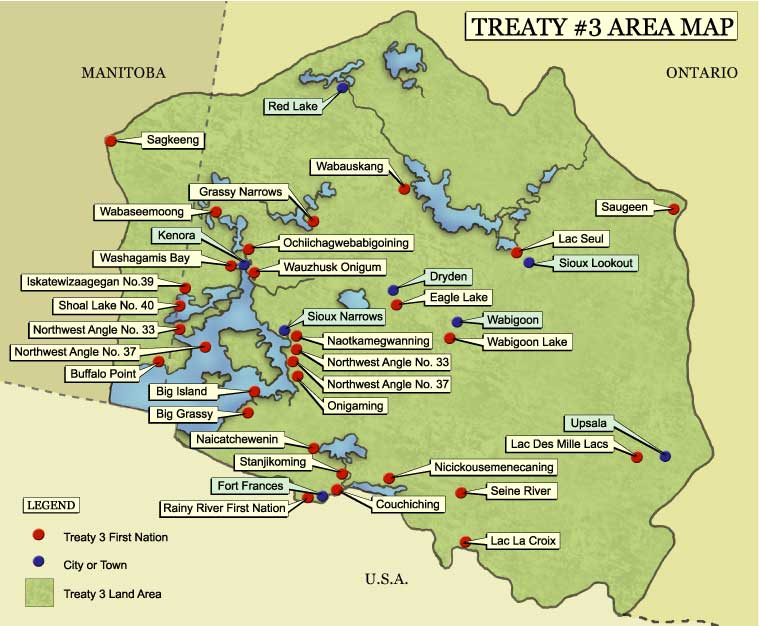
Rainy River First Nation is situated within Treaty 3 territory. Contractors must conduct early duty-to-consult engagements with Chief and Council and follow local community protocols prior to project commencement. Winter conditions between November and April bring sub-zero temperatures, requiring winterized equipment, block heaters, and winter-grade fuel blends. Heavy or oversized freight requires permits from the Ministry of Transportation of Ontario (MTO). Proximity to the U.S. border allows potential cross-border sourcing, requiring adherence to CBSA and U.S. Customs clearance procedures at the Fort Frances-International Falls or Rainy River-Baudette ports of entry.