
Summary
Governance & Leadership
Chief
- Mark McCoy
Councillors
- Jessica Boyer-Bennett
- Luke McCoy
- Gary Roach
- Roxane Robinson
- Joseph Sayers
- Mary Sayers
- Trevor Sayers
- Ann Tegosh
Next Election
July 2027Term of Office
2 YearsGovernment Type
Indian Act Electoral SystemDemographics
Membership (*ISC - As of July 2026)
- 4,025 total membership
- 515 (on-reserve)
- 3,510 (off-reserve)
Reserves
Reserve Land
hectares
2,241.40
acres
5,538.62
km²
22.41
Physical Location
Batchewana First Nation is located in northern Ontario with their traditional lands running along the eastern shore of Lake Superior, from Batchawana Bay to Whitefish Island.
Economic Strategy
Batchewana First Nation of Ojibways advances a sustainable, self-determined economic strategy rooted in Anishinaabe values, treaty rights, and environmental stewardship. Guided by the Seven Grandfather Teachings, the Nation focuses on building long-term financial stability through economic diversification, renewable energy joint ventures, commercial leasing, and proactive land management. By securing meaningful equity stakes in regional clean energy facilities and local industrial enterprises, Batchewana First Nation drives community growth while fostering local career pathways and workforce training. This forward-looking approach balances commercial autonomy with traditional heritage, ensuring that economic success directly supports community services, infrastructure enhancements, and lasting prosperity for present and future generations.
Investment Readiness & Governance
- Establishment of the BFN-RHT Trust (“Asanjigowin”) to steward settlement resources for the long-term benefit of community members.
- Direct equity ownership in major regional renewable energy developments, including utility-scale wind farms and commercial solar projects.
- Implementation of structured corporate governance using bare trustee corporations and dedicated administrative entities to oversee enterprise investments.
Economic Development Corporation

Batchewana Band Industries Limited
Batchewana Band Industries Limited (BBIL) serves as a premier commercial vehicle driving business growth and real estate development for Batchewana First Nation of Ojibways. Operating under a dedicated corporate governance structure, the entity oversees the operation and strategic expansion of the Blue Heron Industrial Park, situated on Nation lands. Through structured commercial leasing, property management, and long-term asset oversight, the corporation generates steady business revenue while establishing a stable environment for commercial and light industrial tenants. Working in alignment with community leadership, Batchewana Band Industries Limited stewards real estate assets, supports local enterprise capacity, and attracts compatible business operations to the region. By maintaining a strong portfolio of income-producing properties and investments, the organization plays a essential role in enhancing economic self-reliance, expanding employment opportunities, and advancing long-term community development objectives across traditional Anishinaabe lands.
Batchewana First Nation of Ojibways - Enterprise Portfolio
Renewable Energy Enterprises
Nodin Kitagan Limited Partnership (Joint Venture / Limited Partnership)
Develops and operates clean wind-powered electricity generation infrastructure at the Bow Lake Wind Farm facility.
Nodin Kitagan 2 Limited Partnership (Joint Venture / Limited Partnership)
Participates in wind power generation operations and green energy facility management as part of regional clean energy initiatives.
Chi-Wiikwedong LP (Joint Venture / Limited Partnership)
Operates the Goulais Wind Farm facility, delivering clean wind-powered electricity under long-term power purchase agreements.
Zaagate Giizis Energy Inc. (Wholly-Owned Corporation)
Constructs, operates, and manages rooftop and ground-mounted solar electrical generation projects across community lands.
GBG-BFN Limited Partnership (Limited Partnership)
Owns and operates commercial rooftop solar electricity generating projects across regional commercial sites in Ontario.
Telecommunications & Technology
Batchewana Telecom Limited Partnership (Limited Partnership)
Delivers telecommunications services and high-speed internet connectivity to underserved rural communities and regional customers.
2856385 Ontario Inc. (Commercial Enterprise)
Holds and manages essential telecom infrastructure assets leased to support regional broadband operations.
Batchewana Telecom Holding Inc. (Wholly-Owned Corporation)
Functions as a bare trustee corporate holding entity overseeing telecommunications equity and partnership interests.
Property Management & Commercial Real Estate
Batchewana Band Industries Limited (Wholly-Owned Corporation)
Manages commercial real estate holdings and industrial park leasing operations, including the Blue Heron Industrial Park.
Batchewana First Nation Housing Authority Incorporated (Wholly-Owned Corporation)
Oversees community housing developments, residential property maintenance, and local housing management programs.
Community & Corporate Support Entities
Batchewana First Nation Long Term Care Home (Wholly-Owned Entity)
Provides dedicated long-term care, residential support, and community healthcare services.
Mukwaa Inc. (Wholly-Owned Bare Trustee Corporation)
Serves as a bare trustee corporate entity holding equity investments in clean energy limited partnerships.
2419656 Ontario Inc. (Wholly-Owned Bare Trustee Corporation)
Acts as a bare trustee holding vehicle facilitating commercial financing and partnership equity holdings.
6597982 Manitoba Ltd. (Wholly-Owned Bare Trustee Corporation)
Functions as a bare trustee holding entity overseeing ownership interests in commercial solar joint ventures.
Mukwaa 2 Inc. (Wholly-Owned Corporation)
Manages specific commercial holding assets and corporate investment structures on behalf of the First Nation.
2425771 Ontario Inc. (Wholly-Owned Corporation)
Serves as a corporate holding entity supporting economic development operations and business management.
Access & Logistics Details
Primary Access:
Batchewana First Nation consists of multiple non-contiguous land bases in the Algoma District, accessible primarily via Highway 17 (the Trans-Canada Highway). The principal land base, Rankin Location 15D, directly borders Sault Ste. Marie and connects to municipal arterial routes including Boundary Road and Trunk Road (Highway 17B). Goulais Bay 15A and Obadjiwan 15E lie approximately 40 km and 80 km north of Sault Ste. Marie respectively, accessed directly via Highway 17 and local paved/gravel roads. All primary populated reserve lands have year-round paved road access with no reliance on ice roads.
Nearest Airport:
The nearest major aviation facility is Sault Ste. Marie Airport (YAM/CYAM), located approximately 25 km southwest of the Rankin 15D land base. YAM features two 6,000-foot paved runways (04/22 and 12/30), supporting scheduled commercial flights, regional air cargo, and heavy charter transport. Water-based charter aviation is available via local operators along the St. Marys River and Lake Superior coastline.
Nearest Commercial Hub:
Sault Ste. Marie, Ontario, serves as the immediate regional commercial, industrial, and service hub for Batchewana First Nation. It provides full access to heavy construction equipment suppliers, freight forwarding depots, industrial repair services, building supplies, fuel distributors, and regional medical facilities.
Marine & Rail:
Marine access is supported by commercial dock facilities along the St. Marys River and Lake Superior in Sault Ste. Marie, providing access to the Great Lakes-St. Lawrence Seaway system via the Soo Locks. Huron Central Railway (HCRY) operates short-line freight rail service east from Sault Ste. Marie to Sudbury, where it interchanges with Canadian National (CN) and Canadian Pacific Kansas City (CPKC) Class I rail networks.
Geographic & Logistical Notes:
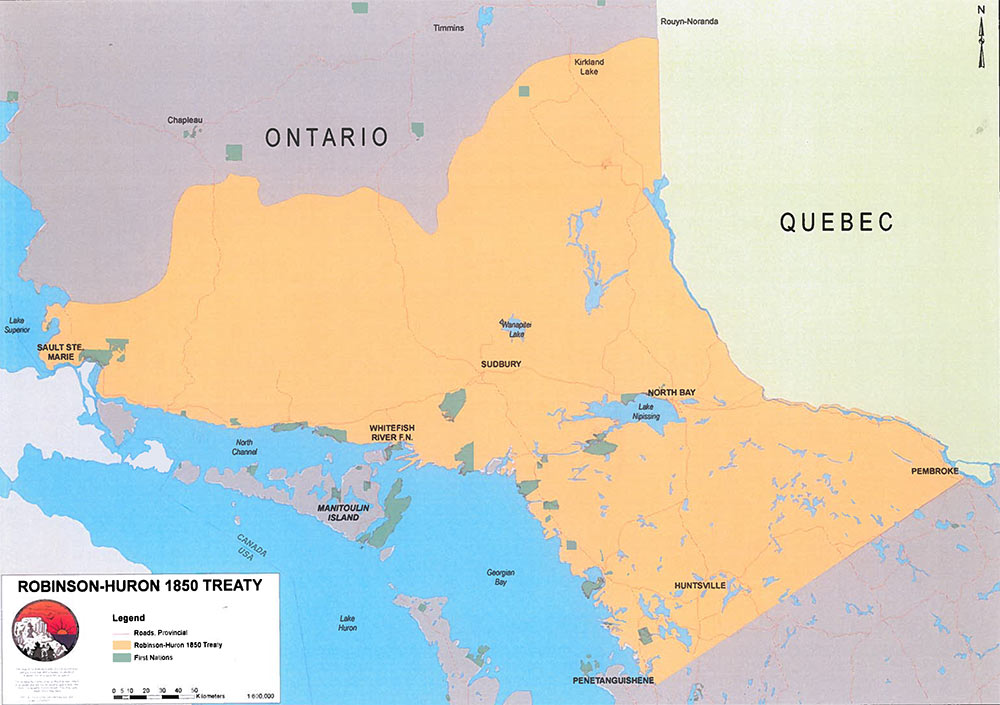
Batchewana First Nation is a Robinson-Huron Treaty (1850) signatory. Operations across its distinct land parcels (Rankin 15D, Goulais Bay 15A, Obadjiwan 15E, and Whitefish Island) require project planners to account for First Nation jurisdiction, consultation protocols, and local employment/contracting preferences. Severe winter weather conditions and lake-effect snow off Lake Superior frequently disrupt transport logistics on Highway 17 between November and April.